Sticks
Sharpening Stones
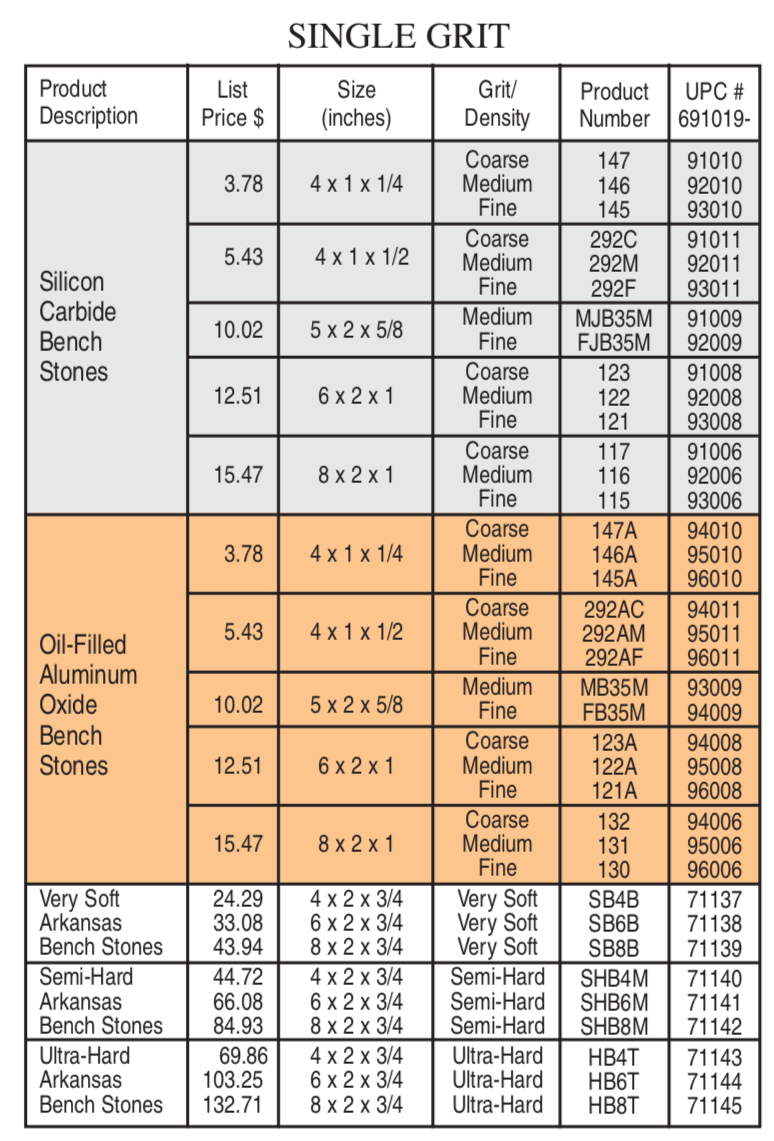
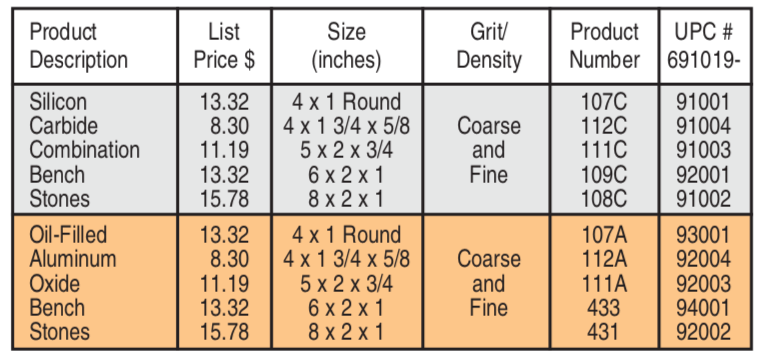
Stocked in coarse, medium and fine grit sizes, silicon carbide bench stones may be used to quickly resharpen a cutting edge, but the resulting edge will not be long-lasting.
Category (Click on a category to scroll to that section)
Bench Stones • Tool Room Files • Speciality Files and Stones • Slip Stones and Silversmiths’ Stones • Hand Rubs, Floor Rubs and Dressing Sticks • Finishing Stones

Stocked in coarse, medium and fine grit sizes, silicon carbide bench
stones may be used to quickly resharpen a cutting edge, but the resulting edge will not be long lasting. (Dark grey in color)
Oil-filled aluminum oxide bench stones are inventoried in coarse, medium and fine grit sizes. Although a user will not be able to quickly resharpen a cutting edge with an aluminum oxide stone, the cutting edge finally achieved will be long lasting. (Orange/Brown in color)
Very soft natural Arkansas bench stones are the best general pur- pose sharpening stones. They offer a user the ability to simultane- ously sharpen and polish a cutting edge. (Speckled brown in color)
Ultra-hard Arkansas bench stones are extremely dense and will enable a user to polish an already sharpened edge to a finish beyond what other stones would yield. They should not be used for general purpose sharpening. (Translucent grey in color)
Semi-hard Arkansas bench stones are flawed ultra-hard stones. The flaw in the stone will be either discoloration or slight density variation. They should be used only to polish pre-sharpened edges. (Colors vary)
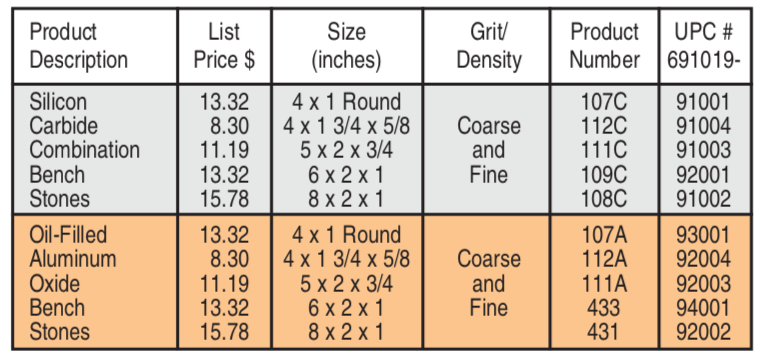
When more than one grit size is necessary to resharpen a cutting edge a craftsman will often use a combination stone to lessen both the expense and the inconvenience of using two single grit stones. Use a silicon carbide stone for sharpening quickly or an oil-filled alu- minum oxide stone for restoring a long lasting edge.

Squares and triangles have both flat sides and long, sharp edges. They are the most popular types of tool room files. Choose both the material and the grit size to arrive at the desired finish in the time allowed. Choose the shape and size that will give you the snuggest fit to the surface being honed.
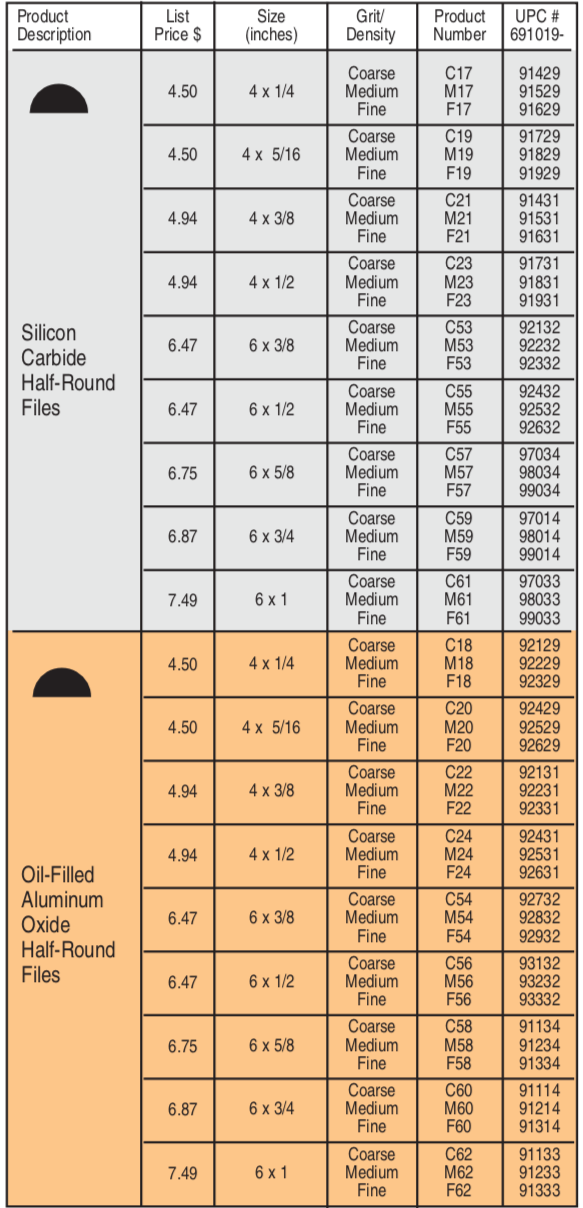
Both rounds and half-rounds offer curved faces to give the user the ability to hone instruments with contoured surfaces. Half-rounds have the extra dimension of a flat side. The denser the material a round or a half- round is made from the better the finish it can offer the user, but the longer it will take him to achieve it.

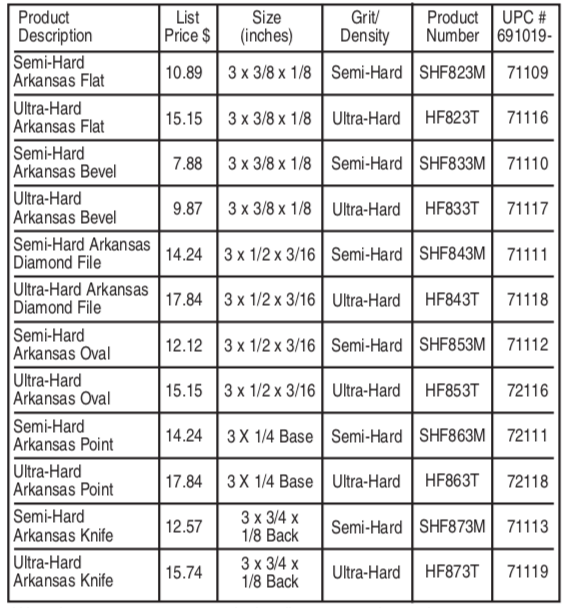
ARKANSAS FILES
Flat files offer the user two good sized polishing surfaces in as small, thin and hard a stone medium that there is available as a standard size. Bevel files have the same polishing surfaces as flat files, but also have both acute and obtuse angles at the edges. They are widely used to repolish the edges and angles of machine parts.Diamond files are widely used on machine parts for cleaning and polishing non-right angles. They are thicker, easier to handle and offer different angles than do bevel files. The unusual shape of an oval file enables an artisan to polish the elliptical recesses and curved edges of exacting instruments. Point files have both sharp points for use by engravers and die sinkers and round surfaces for resharpening contoured faces. Knife blades are primarily used to resharpen both the edges and the points of cutting tools. The long, thin edge also makes a knife blade the preferred choice for deburring the edges of tightly spaced groove fittings
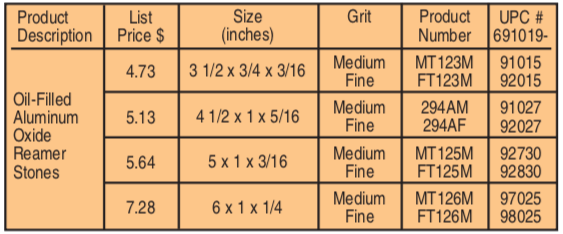
Although reamer stones are used primarily to restore sharp edges on reamers, they are also used frequently on taps and dies.

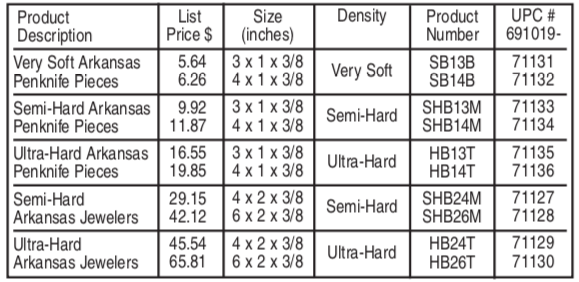
Penknife pieces are very long lasting general purpose edge restorers. They are typically used to polish presharpened edges to a razor sharp finish. Very soft Arkansas stones will complete the job the fastest and ultra-hard Arkansas stones will yield the longest lasting edge. Jewelers stones are used for the precision sharpening of fine cutting tools. Jewelers, engravers and artisans use these stones when penknife pieces are too short.
Jointer stones are typically fitted into fixtures. They are the preferred tool for restoring and maintaining the cutting edges of the mechanical jointing devices on automatic planers.

The machine knife stone is a fast cutting silicon carbide combination stone with a fin- ger protection groove that enables the craftsman to safely resharpen machine mounted knives. It is also frequently used by metal workers to clean and reflatten their tables. The gouge sharpening stone is the favorite sharpening and lapping tool of gouge users and other cutting tool users who must hone both inside and outside curved sur- faces, due to its unusual shape and its composure of long lasting oil-filled aluminum oxide. The silicon carbide utility file will outlast and outsharpen virtually any metal
file. Its tapered shape and long reach make it a favorite for sharpening coarse edges on cutting tools. It is also frequently used to resharpen tire stripping spikes.

The aluminum oxide scythestone will produce a long lasting edge on sickles, scythes and brush hooks. It is typically used between jobs so that upon the next use of the edge resharpening will not be required as quickly. The silicon carbide sickle and scythestone is used to quickly restore the edges of sickles, scythes and brush- hooks. It is often used while on the job. The garden tool sharpener is made from very fast cutting green silicon carbide abrasive and is relatively new to the industrial marketplace. Consumers have for years found the elliptical shape comfortable for stoning both flat and curved cutting edges.

Aluminum oxide griddle bricks have a long history of quickly cleaning restaurant grid- dles without requiring frequent replacement and without leaving contamination. The design of the skiving knife stone has inspired many uses, but this oil-filled aluminum oxide stone is still used mostly by mechanics and machinists for deburring and sharp- ening Amazeen skiving knives. Carbide tool slips are typically used while on the job to maintain the edges of carbide tools. Made from fast cutting green silicon carbide they help to minimize tool regrinding costs.

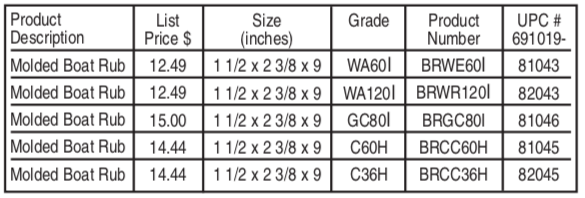
The unique shape of boat rubs allows them to fit easily into machinists’ hands. They are very popular for the initial removal of large die seams and for breaking down sharp edges on machined parts. They are available in many grades. The five most popular grades are shown in this catalog.